Saturday, 17 October 2009

Are we running out of oil?

image 

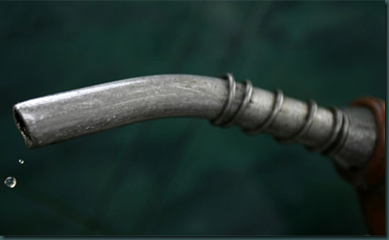
The amount of proven oil reserves awaiting to be exploited fell last year for the first time in a decade, according to new figures released today. The amount of crude left in the ground was 1.258trn barrels - 3bn less than this time last year.

These figures, revealed in the BP Statistical Review of World Energy, are probably the result of a slump in drilling activity due to a fall in the price of oil last year - from $150 per barrel to $30.

At today's rate of use however there is still enough oil to last the next 42 years, according to the oil company although those concerned about Peak Oil say we are closer to running out given demand is expected to rise strongly in the short-term.

Are we running out of oil? The world in energy statistics | Environment | guardian.co.uk

Carbon capture plant backed by EU

image

Plans for Britain's first coal-fired power station equipped with carbon capture technology have been backed by the European Commission.The commission has recommended that a plant in Hatfield, near Doncaster, should receive £164m of EU funding. The sum would be matched by a similar sum from the UK government.

BBC NEWS | England | South Yorkshire | Carbon capture plant backed by EU

Wednesday, 14 October 2009

Global hunger worsening, warns UN

image

Targets to cut the number of hungry people in the world will not be met without greater international effort, UN food agencies have warned.The UN's annual report on global food security confirms that more than one billion people - a sixth of the world's population - are undernourished.

BBC NEWS | World | Europe | Global hunger worsening, warns UN

Q&A: EU immigration policy

Large-scale immigration to the European Union has highlighted big differences in the way the 27 member states handle newcomers from non-EU countries.

African migrants in a boat

African migrants risk their lives to reach the Canary Islands

The impetus for new EU-wide rules is fuelled by: the pace of globalisation; the need to attract more high-skilled workers as Europe's population ages and businesses struggle to compete; and an influx of illegal immigrants to Mediterranean countries.

BBC NEWS | World | Europe | Q&A: EU immigration policy

BBC - Today - Audio slideshow: Selling the suburbs LONDON

 image

As the tentacles of the London Underground network started to spread out at the start of the 20th Century, thousands of new homes were built - and suburbia was born.

The London Transport Museum is hosting a suburban celebration - and Evan Davis met museum director Sam Mullins, and writer Miranda Sawyer, to see how public transport helped families in search of a bay window.

BBC - Today - Audio slideshow: Selling the suburbs

Green 'zero waste' recycling policy could mean up to six bins

image

Householders could be forced to have as many as six bins and sift through every piece of rubbish under Government plans to increase the amount of recycling.

Green 'zero waste' recycling policy could mean up to six bins - Telegraph

Half of babies 'will live to 100'

image

More than half of babies now born in the UK and other wealthy nations will live to 100 years, researchers say.

The study, published in The Lancet journal, also says the extra years are spent with less serious disability.

Data from more than 30 developed countries shows that since 1950 the probability of surviving past 80 years of age has doubled for both sexes.

e than half of babies now born in the UK and other wealthy nations will live to 100 years, researchers say.The study, published in The Lancet journal, also says the extra years are spent with less serious disability. Data from more than 30 developed countries shows that since 1950 the probability of surviving past 80 years of age has doubled for both sexes.

BBC NEWS | Health | Half of babies 'will live to 100'

Sunday, 11 October 2009

Oil production could peak in 10 years' time

There is a 'significant risk' that global oil production will peak in less than ten years' time, say researchers in a report from the UK Energy Research Centre.

Oil rig

The report's authors add there is a growing consensus that the age of cheap oil is coming to an end.

But they warn that governments, including the UK's, are not concerned about global oil depletion, despite the fact that oil provides a third of the world's energy.

As the modern industrial world is largely built on the availability of cheap oil, this is likely to have a huge impact on the global economy.

The whole issue of peak oil has long been contentious. A growing number of commentators say the world is near peak oil production, predicting that oil will run out as reserves become more and more depleted. Others argue we have enough oil to see us well into the twenty-first century.

Oil production could peak in 10 years' time

Migrants, Go Home!

PANORAMA Reporter Paul Kenyon continues his journey out of Africa following the route taken by 40,000 migrants a year seeking a better life in Europe. He discovers the way to the UK blocked by a new hardline policy in France to round up economic migrants and send them home, and an unlikely partnership with Libya's Colonel Gaddafi, who has reached an agreement with Italy to capture Europe-bound migrants at sea and lock them up in desert prisons.http://bbc.co.uk/i/n6x4f/

BBC iPlayer - Panorama: Migrants, Go Home!

How to predict a hurricane

Iceland looks to serve the world

image

Since the financial crisis, Iceland has been forced to retreat back from high octane bubble living to nature.

Fortunately, there is a lot of that nature to retreat to.

It is a breathtaking world of volcanoes, endless prairies and ethereal winter landscapes. Not, you might think, the most obvious place to stick millions of the world's computer servers which are, for all their uses, rather less attractive. But the country now wants exactly that - to become home to the world's computing power.

BBC NEWS | Programmes | Click | Iceland looks to serve the world

BBC NEWS | Business | Fear of steep energy bill rises

image

Domestic UK energy bills could rise by 60% by 2016 in a worst-case scenario identified by the energy regulator.

BBC NEWS | Business | Fear of steep energy bill rises

Exploring Renewable Energy for Sustainable Development in Africa

uk_wind_power

For developing countries, it is obvious that we have a lot of natural resources with the potential to produce alternative energy to combine with the traditional sources such as hydro - electric power and thermal energy technology, which are not environmentally friendly and also susceptible to climate change.

allAfrica.com: Africa: Exploring Renewable Energy for Sustainable Development (Page 1 of 1)

Thursday, 8 October 2009

Warning over global oil 'decline'

image

There is a "significant risk" that global production of conventional oil could "peak" and decline by 2020, a report has warned.The UK Energy Research Centre study says there is a consensus that the era of cheap oil is at an end.

BBC NEWS | Science & Environment | Warning over global oil 'decline'

Wednesday, 7 October 2009

Worldmapper Gridded Population Cartograms: The countries of the world as you've never seen them before

world

Worldmapper has 200 new cartograms which show the world and its countries mapped based on population.  The maps “were created as part of a Leverhulme Trust project to remap the world and extend the Worldmapper project, have been created using population distribution data so viewers can understand how many people make up each nation.” Click on the map to see individual cartograms for each country or pick from the list of countries.

Worldmapper Gridded Population Cartograms: The countries of the world as you've never seen them before

South Africa: surfers in Cape Town claim world record

BBC NEWS | World | Europe | Nuclear Europe: Country guide

nuc_power_sites_466

There are 165 nuclear reactors producing power in Europe (excluding Russia), with six under construction and others planned.

BBC NEWS | World | Europe | Nuclear Europe: Country guide

London on Tap: Reducing Bottled Water Consumption

image

London authorities have paired up with Thames Water, Britain’s largest private water company, to launch a water station program this month that aims to reduce the city’s use of bottled water. Mayor Boris Johnson’s push for more public drinking fountains in addition to the new station program could be the first steps towards banning bottled water in the city, The Guardian reported Sunday.

London on Tap: Reducing Bottled Water Consumption | Circle of Blue | WaterNews