
Saturday, 3 October 2009
Population maps

At first glance they could be mistaken for distorted creepy-crawlies - bloated body parts with randomly placed antennae and spindly legs, their gridlines looking much like the compound eyes and variegated wings of an insect. In fact, each image is a country map - reinterpreted by a pair of Sheffield University geographers. The result is a remarkable series of cartographic designs that cast the world in an entirely new light.


Sumatra quake 'levelled villages'

Thousands of people may have died in remote village areas when a powerful earthquake struck Sumatra last week, emergency workers and officials fear.

http://www.geography.org.uk/resources/earthquakes/
BBC NEWS | World | Asia-Pacific | Sumatra quake 'levelled villages'
http://www.boston.com/bigpicture/2009/10/2009_sumatra_earthquakes.htmlAbout 5:00 pm on September 30th, a magnitude 7.6 earthquake struck just offshore of the town of Padang in Sumatra, Indonesia. The quake toppled buildings and started many landslides, smashing homes and swallowing up entire villages. The following day, As rescue workers arrived and residents tried their best to dig out and help the survivors, another unrelated quake with a magnitude of 6.6 struck less than 1,000 km south of the original epicenter. Each of the two quakes had at least one aftershock greater than 5.0 as well. Over 1,000 people are known to have died, an additional 3,000 still missing. Today, October 5th, officials called off the search for survivors in Padang, and are focusing now on caring for the living and coordinating with international relief agencies
Wednesday, 30 September 2009
Dozens dead in Indonesian quake
At least 75 people are dead and thousands are trapped under rubble after a strong earthquake shook western Indonesia, officials say.Buildings, including at least two hospitals, were brought down by the 7.6 magnitude quake, centred about 50km (30 miles) off the coast of Sumatra. Officials say the death toll is expected to rise. It comes hours after a tsunami from a separate quake killed more than 100 people in the South Pacific. A tsunami watch issued by the Pacific Tsunami Warning Center in the wake of the Indonesian quake has been lifted.

BBC NEWS | World | Asia-Pacific | Dozens dead in Indonesian quake
Tuesday, 29 September 2009
BBC - Wildlife Finder

Journey with Sir David Attenborough as he shares his favourite moments from the last 30 years of wildlife film making. Dive into the BBC's archive, explore the wealth of video, sound, stories and breaking news, and let the greatest show on Earth unfold.
geographyalltheway.com - GCSE / IGCSE Geography - Energy and Water Resources

Candidates should be able to
- Describe the significance of fuelwood in LEDCs and of non-renewable fossil fuels in terms of their availability in certain areas and in terms of the contribution made by coal, oil, natural gas and wood in supplying vast amounts of energy.
- Describe the growing significance of renewable energy supplies [geothermal, wind, running water, solar, biogas] to reduce dependence upon fossil fuels, to alleviate the world's energy crisis, and to offer opportunities for the development of alternative energy sources.
- Describe the factors influencing the siting of different types of electrical power stations with reference to those listed in the Syllabus [thermal, hydro-electric power, nuclear].
- Describe the uses made of water for agriculture, domestic and industrial demand. Candidates should also recognise that in certain areas there are water shortages which impact upon the local people and the potential for development. This leads to competition for the use of the available water resources and requires careful management.
All these aspects would benefit from the selection of appropriate case studies.

geographyalltheway.com - GCSE / IGCSE Geography - Energy and Water Resources
BBC - GCSE Bitesize - Energy

All life on earth is sustained by energy from the sun. Plants and animals can store energy. Some of this energy remains with them when they die. It is the remains of the stored-up energy of ancient animals and plants that make up the fossil fuels that power our cars and factories today.But fossil fuels are non-renewable energy sources and will one day run-out and because burning them generates greenhouse gases, relying on fossil fuels for energy generation is unsustainable. Hence the need to find more renewable, sustainable ways of generating energy.
Energy Resources: Fossil Fuels

What do I need to know?
"Energy Resources" is NOT the same thing as "Types of energy".
"Types of energy" means "kinetic energy", "chemical energy" and so forth.
"Energy Resources" is about ways of getting energy so we can generate electrical power.


BBC NEWS | World | Africa | Life dries up in Kenya's Mau forest

High in the hills of Kenya's Mau forest, some 20,000 families are facing eviction from their farms - accused of contributing to an ecological disaster which has crippled the country.

THE HEART OF KENYA
Mau forest is the largest in Kenya - the size of the Aberdares and Mount Kenya combined
10 million people depend on its rivers
They feed six lakes - Victoria, Turkana, Natron, Nakuru, Baringo and Magadi
Plus eight wildlife reserves - including the Masai Mara, the Serengeti and Lake Nakuru
The rivers have potential for 518MW hydro electricity - 41% of Kenya's total
In all, the forest provides an economic benefit of 20 billion shillings (£166m) per year (UNEP)
But already, a quarter of its 400,000 hectares have been destroyed by farmers and loggers
BBC NEWS | World | Africa | Life dries up in Kenya's Mau forest
Sunday, 27 September 2009
Can China help to defuse the nuclear threat from Iran?

As a veto-holding permanent member of the UN Security Council, China's position will be crucial to international efforts to deal with Iran's secret nuclear facility.
"Iran is an important country for China: we have diplomatic interests, but also energy and trade links," he said. "[And] if China is too harsh, it will not be favourable to its image and influence in the Middle East."
China is the world's second-largest consumer of crude oil while Iran has the world's second largest reserves; Iranian oil made up more than a tenth of China's crude imports last year. Earlier this year, the two countries announced a $3.2bn three-year natural gas deal, and in the spring Iran's Press TV reported that trade volume between the countries leapt from $400m in 1994 to $29bn in 2008.
Can China help to defuse the nuclear threat from Iran? | World news | The Observer

Iran and United States on collision course over nuclear plant | World news | The Observer

The US and Iran raised the stakes yesterday ahead of this week's nuclear showdown in Geneva, with threats of global strife if no resolution is found.
The sharpened rhetoric followed Friday's revelation that Iran had been building a secret uranium enrichment plant under a mountain near Qom, and it points towards a new wave of sanctions that go far beyond the targeted financial measures imposed on Iran so far.

Speaking at the G20 summit in Pittsburgh, Barack Obama declared: "Iran is on notice that when we meet with them on 1 October they are going to have to come clean, and they will have to make a choice." The alternative to sticking to international rules on Iran's nuclear development, he said, would be "a path that is going to lead to confrontation".

Iran and United States on collision course over nuclear plant | World news | The Observer

Iran defiant over secret nuclear facility
BBC Iran conceal nuclear facility
10:10 | What is 10:10?

10:10 is an ambitious project to unite every sector of British society behind one simple idea: that by working together we can achieve a 10% cut in the UK’s carbon emissions in 2010.
Why bother jumping out of the way of a speeding car? Why bother removing a burst appendix?
Cutting 10% in one year is a bold target, but for most of us it’s an achievable one, and is in line with what scientists say we need over the next 18 months. We now know for certain that unless we act quickly to reduce our use of dirty fossil fuels, humanity will face terrible problems in the years to come. Politicians have so far failed to do what needs to be done, so it’s time for ordinary people to step in and show that we’re ready to defend our children’s futures. It’s now or never for the climate.
Saturday, 26 September 2009
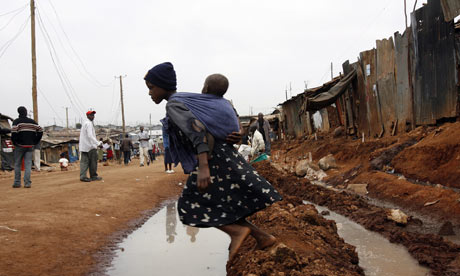
Kenya's slums attract poverty tourism
Tourists snapping up £20 guided walks around Nairobi's open-sewer streets
The streets of Kibera, Nairobi, are attracting the interest of tour operators - but critics say the residents are on parade like animals. Photograph: Stephen Morrison/EPA
The Dutch tourists came well prepared for the walking safari: strong shoes and sunscreen, backpacks and bottled water. Ahead lay an afternoon visiting one of Kenya's most recognisable sights – but one that rarely features in tourist brochures.
"It might seem a bit strange to come here," said Eric Schlangen, as the guide led him towards the sea of tin-roofed shacks that constitute Kibera, often described as one of the world's largest slums. "But I wanted to see how people live in this country, not just the animals."
Slum tourism is taking off in Kenya. Several local organisations have started selling guided trips through Kibera, a short drive from the luxury hotels that serve most foreign visitors in Nairobi.
For about £20, tourists are promised a glimpse into the lives of the hundreds of thousands of people crammed into tiny rooms along dirt paths littered with excrement-filled plastic bags known as "flying toilets", as one tour agency explains on its website.
Kenya's slums attract poverty tourism | World news | The Guardian
Very young children among migrants heading for UK, warns UN refugee agency

The UN's refugee agency warned today that children as young as three are among the migrants attempting to reach Britain and that the number of unaccompanied refugee children is on the increase.There is evidence that ever younger children are attempting dangerous journeys around the world, said William Spindler, spokesman for the UN high commissioner for refugees (UNHCR).
New surfers' reef fails to make waves

In the parlance of the surfing community it was supposed to attract, Bournemouth's new £3m underwater reef was meant to be Gnarlatious, creating giant Honkers from Atlantic swells and so bringing in legions of Dudes and Dudettes who flock to resorts in Cornwall and Devon each year to ride Bamboras.Instead it has turned out to be Bogus, and is making waves for all the wrong reasons.As work on the reef at Boscombe comes to a close, surfers say there is still no sign of the promised "world-class" waves it was meant to create. Residents are furious that the project, which is more than a year behind schedule and has cost three times the original budget, is failing to deliver.
New surfers' reef fails to make waves - This Britain, UK - The Independent
Friday, 25 September 2009
Ozone Hole Appears On the Mend

Satellite instruments monitor the ozone layer, then the data are used to create images that depict the amount of stratospheric ozone. The blue and purple colors are where there is the least ozone, and the greens, yellows, and reds are where there is more ozone.The size of the hole in stratospheric ozone that develops over Antarctica at this time each year appears to have stabilized, according to satellite observations analyzed by various agencies around the world. Matthew Tulley from Australia’s Bureau of Meteorology says the hole has begun to show signs of healing because of the international agreement to phase out the production of ozone-depleting chemicals in the 1987 Montreal Protocol. Recent observations indicate that the level of ozone-depleting substances has decreased by 4 percent since 2001.
Thursday, 24 September 2009
Artic Survey education

Arctic Survey Education is an initiative to promote climate change awareness by inspiring and engaging young people and their families with new facts and knowledge. The Arctic Ocean sea ice cover may melt in just four years or in fifty years. Scientists need data so that they can forecast more precisely. The Catlin Arctic Survey team has provided ice and snow thickness data from their expedition to the Arctic Ocean during March, April and May 2009.
The Solucar solar power plant in Sanlucar la Mayor near Seville, Spain - Telegraph
The new PS20 solar tower gathers sunlight at the Solucar Platform in Sanlucar la Mayor, southern Spain


The Solucar solar power plant in Sanlucar la Mayor near Seville, Spain - Telegraph
Rash of Water Main Breaks Points To Vulnerability of Systems
Recent water main breaks highlight challenges to water infrastructure.Major water main breaks in Los Angeles and Baltimore in recent days highlight challenges to the U.S. water infrastructure system.
A rash of water main breaks in the Los Angeles water system this month have flooded streets, forced residents to evacuate, and damaged homes and businesses, the Los Angeles Times reported. One break created a sinkhole that nearly swallowed a firetruck responding to the scene, while another sent a surge of mud and water 10 feet into the air.
Since the start of September, L.A.’s Department of Water and Power has recorded 34 “major blowouts” in the city’s water system, the Los Angeles Times reported Sept. 19. By contrast, the city had only 21 such ruptures through all of September 2008, 17 in September 2007 and 13 in September 2006.

Rash of Water Main Breaks Points To Vulnerability of Systems | Circle of Blue | WaterNews
BBC NEWS | World | Getting ready for the storm surge

Millions of people who live in low-lying coastal areas of the Netherlands, Germany, Denmark, Belgium and the UK are at risk from a severe storm surge.A major exercise is under way in the Netherlands in which British specialist rescue teams, as well as those from other European countries, are simulating what might happen in the event of a major North Sea flood.
VIDEO
Wednesday, 23 September 2009

Saturday, 19 September 2009

Wednesday, 16 September 2009
Magazine / Geographical

Build flood defences, examine glaciers, advance renewable energy technologies, monitor water quality and more with a degree in geography. Read the FREE I am a Geographer careers supplement to find out more

Monday, 14 September 2009
Storm chaser

The extreme weather photographer and storm chaser Jim Reed has spent the past 20 years as close as possible – perhaps closer than is advisable – to the most extreme meteorological events. Covering disasters such as Hurricane Katrina and Hurricane Ike, Reed's book, Storm Chaser: A Photographer's Journey, documents his time in the field.
Surviving the direct strike of 17 hurricanes in the US, 2010 marks Reed's 19th consecutive year of extreme weather photography. Reed currently has images being shown at the Corcoran Gallery of Art in Washington
In pictures: Storm chaser Jim Reed | Environment | guardian.co.uk
How drought is destroying Kenya's nomad
In the isolated border lands between Kenya and Somalia, families have always clung to a precarious existence. Now a decade of droughts has tested their endurance
VIDEO
How drought is destroying Kenya's nomads | Environment | The Observer

Saturday, 12 September 2009
Where the Premier League's players come from
Globalisation and sport. INTERACTIVE MAP
BBC SPORT | Football | Premier League | Where the Premier League's players come from
Thursday, 10 September 2009

Brits Abroad

World overview Welcome to Brits Abroad – a comprehensive guide to where Britons live around the world. Use the tabs above to explore the information, compiled by the Institute for Public Policy Research.
Wednesday, 9 September 2009
How to measure an earthquake
Originally, Charles Richter used information from seismographs - which measure earth movement - to work out the location and size of a tremor.
He developed a sliding scale based on the distance between an earthquake and the seismograph station where the quake was recorded and the amplitude of the largest seismic wave measured.

Tuesday, 8 September 2009
Intute - Natural hazards


These pages draw together resources about a range of natural hazards. These resources include satellite images, maps, articles, links to data, information on current and historical events, links to sources focusing on the measurement/classification of events, combined with links from the Intute Internet resource catalogue. Together these provide a growing resource about natural hazards around the globe.
Atlas Obscura

Welcome to the Atlas Obscura, a compendium of this age's wonders, curiosities, and esoterica. The Atlas Obscura is a collaborative project with the goal of cataloging all of the singular, eccentric, bizarre, fantastical, and strange out-of-the-way places that get left out of traditional travel guidebooks and are ignored by the average tourist. If you're looking for miniature cities, glass flowers, books bound in human skin, gigantic flaming holes in the ground, phallological museums, bone churches, balancing pagodas, or homes built entirely out of paper, the Atlas Obscura is where you'll find them.
Sunday, 6 September 2009
BEEP BioEthics Education Project: Biodiversity

What is biodiversity? The Earth contains a rich and diverse assembly of organisms. This is known as Biodiversity and was defined by UNEP in 1995:
Wednesday, 2 September 2009
Aral Sea Continues to Shrink, August 2009 : Image of the Day

Throughout the first half of the twentieth century, the Aral Sea was the world’s fourth-largest lake. In the 1960s, the Soviet Union began a massive irrigation project in what are now Kazakhstan, Uzbekistan, and Turkmenistan, diverting water from the rivers that feed the Aral Sea to irrigate farmland. As its water levels dropped, the lake began splitting into smaller pieces: the Northern (Small) Aral Sea and the Southern (Large) Aral Sea. The Southern Aral Sea further split into eastern and western lobes. The Earth Observatory’s World of Change: Evaporation of the Aral Sea feature tracks this process over the past decade.
Aral Sea Continues to Shrink, August 2009 : Image of the Day
A vision of Britain in 2020: power cuts and the 3-day week
Britain's homes could be without light and heat for long periods by 2020 with the government being forced to repeat the 1974 imposition of power cuts by rota, a doom-laden report by the Institution of Civil Engineers (ICE) says today.
By then, 80% of the gas to fuel Britain's power stations and domestic central heating will be piped "from politically unstable countries thousands of miles away." Mechanical failure, sabotage and terrorist attack would lead to power cuts within days, the report says. The society, established in 1818, says Britain will be at the end of a pipeline which passes through several other countries relying on imported gas.
A vision of Britain in 2020: power cuts and the 3-day week | Politics | The Guardian
Subscribe to:
Posts (Atom)