The Italian town of L'Aquila is welcoming leaders of the G8 group of industrialised nations for its annual summit, just three months after it was hit by a strong earthquake.

Here are some of the topics they will be discussing:
The Italian town of L'Aquila is welcoming leaders of the G8 group of industrialised nations for its annual summit, just three months after it was hit by a strong earthquake.
Here are some of the topics they will be discussing:


The monsoon is late, the wells are running dry and in the teeming city of Bhopal, water supply is now a deadly issue. Gethin Chamberlain reports

India prays for rain as water wars break out | World news | The Observer
A new online tool puts the power of information in the hands of anyone who's interested, and turns data into animation.
Video availabe from the BBC here


Costa Rica is the greenest and happiest country on the planet, according to the rankings developed by think tank the New Economics Foundation, followed by the Dominican Republic and Jamaica.
The UK comes in at 74 out of 143 countries behind post-Soviet Georgia at 72, the military dictatorship Burma at 39 and Sri Lanka, which has been scarred by civil war, at 22.
The highest ranking country in the EU was the Netherlands at 43 followed by France at 71 and Germany at 51.
The United States, was ranked at 114, Canada at 89 and Australia at 102. Zimbabwe and other poor African nations, where life expectancy and happiness is low, came bottom of the table.
Economists said the richer countries came lower in the ranking because of the high carbon footprint of the population, measured by looking at how much of the world's resources people consume per capita.
Levels of life satisfaction, calculated from a worldwide poll, were also not necessarily high in rich countries where violence and inequality continue to be a problem.
In the UK the low ranking was largely due to social problems or what has been labelled "broken Britain" and the high carbon footprint of most of the population.
If everyone in the world wanted to live as people do in the UK, it would require the resources of more than three earths.
Nick Marks, who devised the rankings, said that there are still high levels of inequality in the UK as well as community breakdown and unhealthy lifestyles.
"There are a lot of people who are unhappy particularly at the lower income end of the spectrum but it is not only financial inequality, it is the longer working week, a lack of social cohesion through a sense of belonginess to the community or the geographic area, indebtedness, low levels of volunteering and more passive lifestyles," he said.
He urged politicians to pay more attention to life satisfaction over GDP.
"The big message of these rankings is that we have to produce a system that makes people happier without costing the earth," he said.

A concerted programme of action in response to climate change is being pursued across the Government, led by DECC and Defra.
Starting with the publication by Defra of the latest UK Climate Projections, Ministers will this summer set out the building blocks of a ‘five point plan’ designed both to reduce emissions at home and abroad and to protect and prepare for the changes that are already inevitable.

The British public could invest their savings in the UK's renewable energy revolution and reap the financial rewards of helping to save the planet, under ambitious plans to be discussed this weekend.The Public Interest Research Centre, a thinktank based in Wales, says the government could sell "energy bonds" to pay for the required investment. The scheme would be similar to war bonds, which galvanised financial support in Britain during the second world war.
The idea is one of 20 radical solutions to the threat of global warming to be proposed during presentations this weekend in Manchester. The event, organised by the Guardian and the Manchester International festival, will publish a report on the ideas, which will be distributed ahead of key UN talks on a new climate treaty in Copenhagen in December.
6 climate plans1 . Methanol 2. Algal Fuels 3. Ocean cloud seeding 4. Bio char 5.Global population control 6. Energy Bonds
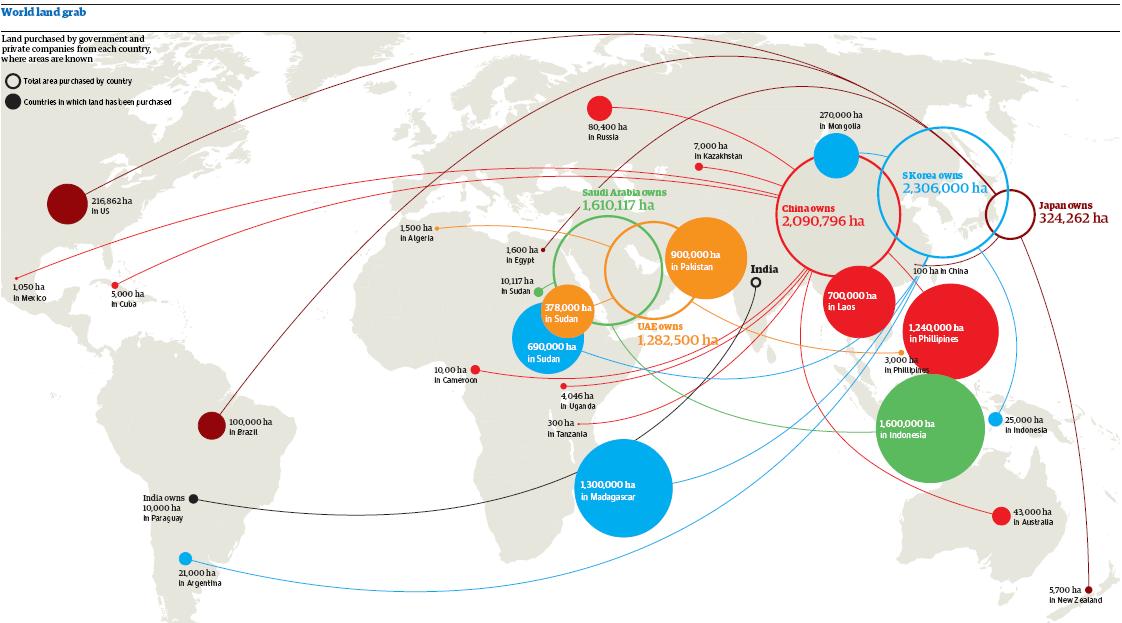
The acquisition of farmland from the world's poor by rich countries and international corporations is accelerating at an alarming rate, with an area half the size of Europe's farmland targeted in the last six months, reports from UN officials and agriculture experts say.
New reports from the UN and analysts in India, Washington and London estimate that at least 30m hectares is being acquired to grow food for countries such as China and the Gulf states who cannot produce enough for their populations. According to the UN, the trend is accelerating and could severely impair the ability of poor countries to feed themselves
Fears for the world's poor countries as the rich grab land to grow food | Environment | The Guardian
OPEC's mission is to coordinate and unify the petroleum policies of Member Countries and ensure the stabilization of oil markets in order to secure an efficient, economic and regular supply of petroleum to consumers, a steady income to producers and a fair return on capital to those investing in the petroleum industry.

Our Cause Oil sits at the center of most of our greatest environmental, health, human rights and security challenges today. Oi is fully integrated into the structures and operations of governments, economies and societies around the world, especially in the U.S.
Our Mission Our mission is to increase choice by decreasing and ultimately ending global oil dependency through educating and moving individuals, governments, and civil society towards non-petroleum sources of energy.

Home - Department of Energy and Climate Change
Statistics available from http://stats.berr.gov.uk/uksa/energy/sa20090528.htm
Subject and table number
Title
Total Energy 1.1 Indigenous production of primary fuels
1.2 Inland energy consumption: primary fuel input basis
Coal 2.4
Coal production and foreign trade 2.5 Coal consumption
2.6 Stocks of coal
Oil 3.10 Indigenous production, refinery receipts, imports and exports
3.11 Stocks of petroleum
3.12 Refinery throughput and output of petroleum products
3.13 Deliveries of petroleum products for inland consumption
Gas 4.2 Natural gas production and supply
4.3 Natural gas imports and exports
Electricity 5.3 Fuel used in electricity generation by major producers
5.3 wind Fuel used in electricity generation by major producers including wind data
5.4 Electricity production and availability from the public supply system
5.4 wind Electricity production and availability from the public supply system including wind data
5.5 Availability and consumption of electricity
Temperatures 6.1 Average temperatures and deviations from the long term mean
6.2 Average wind speed and deviations from the long term mean
Prices 2.1.1 Retail prices index: fuel components
2.1.2 Retail prices index: fuel components, relative to GDP inflator
2.1.3 Retail prices index: fuels components monthly figures
4.1.1 Typical retail prices of petroleum products and a crude oil price index (monthly data)
4.1.2 Typical retail prices of petroleum products and a crude oil price index (annual data)
5.1.1 Premium unleaded petrol prices in the EU
5.2.1 Diesel prices in the EU

How to read the graph?
The WPI assesses water poverty from 5 different perspectives: available resources, use of them, access to water (water supply, sanitation and irrigated land), capacity of exploitation, as well as environmental sustainability factors. In each category up to 20 points can be reached (=best situation).
The WPI is a holistic water management tool that is mainly relevant at the community level, but can also be applied at any spatial scale up to the basin or national levels.
Water Monitoring Alliance : indices
http://www.ceh.ac.uk/sections/hrr/documents/WPI4pageleaflet_000.pdf
http://www.ceh.ac.uk/sections/ph/documents/WPIworldmap_2.pdf
More than twice as expensive as the Three Gorges Dam and three times longer than the railway to Tibet, the 50-year, $62bn (£40.67bn) project aims to channel a greater volume than the Thames along three channels – each more than 600 miles long – from the moist Yangtze basin up to the dry lands above the Yellow river.
At Jiaozuo, giant drills have already gouged out more than half of the 2.5 mile-long tunnel that will take the water under the Yellow river. At the foot of the construction shaft, the nine-metre wide concrete pipe stretches into the dark far below the farm fields that stretch towards the river. "This is a first in the history of the Yellow," one of the engineers, Han Jiping, says proudly. "There is nothing to compare."

With China hosting the Olympic Games and water from the South-to-North Water Diversion Project – the largest of its kind ever undertaken – scheduled to begin supplying a thirsty Beijing, 2008 is shaping up to be a major showcase year for the country. This massive scheme has already taken 50 years from conception to commencement and is expected to take almost as long again to construct. Planned for completion in 2050, it will eventually divert 44.8 billion m³ of water annually to the population centres of the drier north.
When finished, the work will link China’s four main rivers – the Yangtze, Yellow River, Huaihe and Haihe – and requires the construction of three diversion routes, stretching south-to-north across the eastern, central and western parts of the country.
The complete project is expected to cost $62bn – more than twice as much as the country’s controversial Three Gorges Dam.